September 30, 2026
In the digital world,
the scarce resource in the AI era is no longer information, it’s judgement

Are your company’s productivity gains from AI employee layoffs reducing your capability to make good decisions based on judgment?
In the rush to deliver measurable value and ROI from their early AI investments, companies have emphasized the productivity gains from major employee layoffs.
Recent AI-Related Layoffs (2024–2025)
- Tens of thousands of U.S. job cuts have been attributed directly to automation and AI adoption.
- Since 2000, automation (including AI-driven systems) has contributed to the loss of approximately 1.7 million U.S. manufacturing jobs.
- Surveys show that roughly 1 in 7 workers report having personally experienced job displacement due to automation or robotics.
AI Job Projections: What’s Expected Between 2026 and 2030?
Major research firms and economic studies forecast significant workforce transformation over the next five years.
U.S. Projections
- Approximately 6% of U.S. jobs (around 10 million roles) could be automated by 2030.
- Up to 30% of U.S. jobs may have substantial portions of their tasks automated.
- As many as 60% of jobs could see meaningful workflow changes due to AI integration.
While those short-term numerical gains may seem enticing, they overlook the long-term consequences of losing the unique value of how work actually gets done in most organizations. Every company has its own operating and cultural nuances that don’t show up in its strategic plans or organization charts which are driven by “explicit knowledge.” Namely, how does work really get done in this organization? Much of the answer to that question resides in the “tacit knowledge” of its employees.
Explicit knowledge is the structured set of information that can be recognized, recorded, stored, and shared. Tacit knowledge is an unrecorded, hidden, and unstated huge repository of knowledge, which is possessed by every person working in the company.
While explicit knowledge can define a company’s goals, objectives, operating processes, and workflows, it doesn’t address the reality that in many cases the organization succeeds or fails based on how effective tacit knowledge is in dealing with exceptions, local practices, work arounds, and ultimately judgement.
How does AI, GenAI & Agentic AI change this structural dynamic?
While there are some initial cost savings and productivity gains from AI, there is also mounting evidence that when it’s implemented without proper training and transparency it can lead to hidden increased productivity costs. A recent survey of 2,500 knowledge workers from Adaptavist Group documented the following:
- 42% say they spend more time verifying AI output that they save using it
- 52% say they regularly spend time correcting AI-generated work from colleagues
- 49% say low-quality AI output slows down projects
- 55% say AI-generated content reduces overall team efficiency
- 46% say it makes their work feel “more repetitive and less meaningful”
In his thoughtful and very thorough articles in The Structural Enterprise Series, Chris Nardecchia SVP/CDIO at Rockwell highlights the shift and impact that AI is bringing to companies. Here is a segment from that series he calls the “decisive shift”:
“The Industrial Revolution amplified human muscle. The Digital Revolution amplified access to information. The AI Revolution amplifies cognition. This is not simply the next technology wave. It is a change in what is scarce.
For generations, competitive advantage came from controlling access to information: better data, faster reporting, more comprehensive analysis. Organizations optimized for information flow. Those who had more of it, faster, made better decisions.
AI changes this completely.
Information is no longer scarce. It is increasingly abundant, synthesized, and available. The model can collect the evidence, test the assumptions, surface the alternatives, stimulate the outcomes, and identify the contradictions, in minutes rather than months.
What AI cannot do is decide.
More precisely: AI cannot evaluate its own recommendations with the domain expertise, contextual understanding, and casual reasoning that turn a plausible analysis into a trusted decision. It can tell you what the data suggests, it cannot tell you whether the data is telling the right story.
The purpose of AI is not to accelerate intuition. It is to make disciplined judgement economically scalable. Going forward, companies will compete on how effectively they allocate human judgement across an increasingly intelligent enterprise.”
The widespread emergence of AI, GenAI & Agentic AI is forcing both companies and their employees to rethink what is the best utilization of both in order to successfully compete as a digital enterprise. Recent studies have shown that AI works best not when it replaces humans, but when it augments them. Thomas W. Malone, Director of the MIT Center for Collective Intelligence (CCI) puts it this way: “Combinations of humans and AI work best when each party can do the thing they do better than the other party. It’s not about dividing tasks linearly between humans and machines but redesigning the entire process so they can collaborate effectively.” For both leaders and employees alike, the key is to learn how people and intelligent technology can co-create business value across every enterprise.
Box Software has embraced this approach by pitching AI to its employees as an enabler and amplifier of their skills, not a replacement for their job. Ravi Malick, global CIO at Box, says they are asking new questions about this approach such as:
- What are the things we can do now that we weren’t able to do before?
- How can we apply your years of experience and intellectual power toward other areas that we just couldn’t get to before?
Microsoft CEO, Satya Nadella, describes this new hybrid model as the incorporation of “human capital” with “token capital.” The former is “the human knowledge, judgement, relationships, ingenuity, and pattern recognition while the latter is in built and owned AI capabilities. The opportunity is in melding the two into a learning loop.”
“In this loop, humans will guide AI systems, set goals, and identify patterns, so AI isn’t running in circles. Every improved workflow generates a better training signal, which accelerates the accumulation of tacit knowledge unique to the firm.”
A strategic framework to redesign how a company operates as a digital enterprise
Companies of all sizes across all industries are complex multi-faceted organizations that are in constant pursuit of sustainable growth and profits. This pursuit defines what markets they pursue, what products and services they build, what organizational structures they create, and what systems, processes, and workflows they rely on to make multiple operating decisions and set investment priorities.
In order for organizations to make substantive changes to their operating or business model to compete as a digital enterprise requires leaders who are committed to freeing their company’s future from the pull of its past.
At the foundation of this operating/business model redesign is an assessment of where the company is currently spending its time and money. For most well-established companies, the vast majority of their resources and budgets are allocated to running the business they have, not growing the business they want to have.
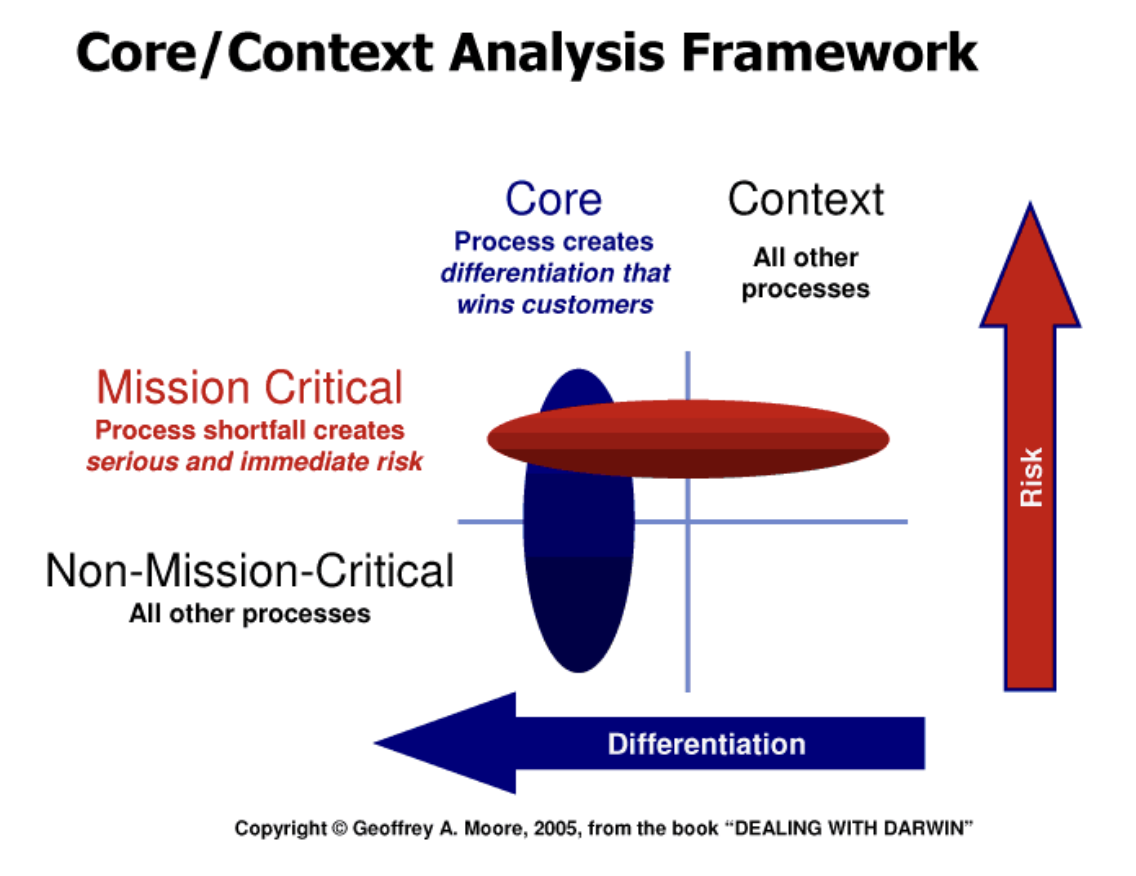
My brother, Geoffrey Moore, developed the core and context framework to draw clear distinctions between the different types of work employees are engaged in across any enterprise which is shown on the chart above. As he states:
- Core are those activities (e.g. product development & sales) that increase a company’s sustainable competitive advantage and directly impact the operating and financial performance of the company. The goal is to create true differentiation by giving customers what they want and cannot get from anyone else.
- Context are all the other activities (e.g. finance & legal) that must be done but do not directly drive increased revenues, margins, and profits. The goal is to, whenever possible, outsource context work in order to redeploy resources, time, and budget against core work.
Based on my work with dozens of companies over the past 20 years, I have seen first-hand that from the C-Suite on down, individuals spend 80% of their time on context and 20% of their time on core. The key to this redesign approach is to fully understand where to combine what humans do best with what machines do best.
A recent McKinsey field research study involving more than 2,300 people working with AI agents showed these results:
- Communication within teams increased by 137%
- Employees spent 23% more time on idea generation (core) & 20% less time on editing (context)
- There was a 60% increase in productivity per worker and a significant improvement in the quality of the creative output
AI did what it does best, which freed up humans to do what they do best.
The first step is to clearly identify high-volume, low-value context tasks across the organization where time and talent are being drained.
The next step is to identify pilot use cases where employees and AI agents can work together to see if they can rebalance how the work is done between them. They can learn from the results of these early pilots to refine their collaborative approach going forward. This approach ensures Agentic AI adoption is sustainable and delivers real business value without overwhelming teams and disrupting existing workflows.
Governance and oversight are critical in maintaining a human-in-the-loop approach for mission critical core decisions that directly impact customer experiences, security, and regulatory & compliance risk.
Successfully operating as a digital enterprise won’t come from implementing isolated tools and APIs; it will come from how effectively organizations combine what humans do best with what AI does best. The ultimate goal is to increase the ability of your company to make mission critical decisions based on good judgement.
|