April 29, 2026
In the digital world,
decision latency does more damage than operational latency
How good is your company at making decisions?

The speed and complexity of change from disruptive technologies puts an even greater pressure on the need to change the decision-making clarity and cadence of your company. The risks of taking too long to make a decision in many cases outweigh the risk of making the wrong decision especially if you can learn from it and quickly make a new and better decision.
The frequency and pace of change from digital disruption necessitates that companies can no longer rely on traditional planning and decision-making models. Simply put, they are too slow, too rigid and too process driven to adapt to the new speed of business.
- A recent research study by Bain & Company found that decision making effectiveness drives 95% of business performance
- Research from McKinsey has documented that companies with fast, high-quality decision making significantly outperform their peers
- Korn Ferry’s research on the critical drivers of business transformation shows that decision-making sits at the center of that dynamic, shaping how effectively organizations translate strategy into execution
Early adopters of new digital technologies like AI, GenAI & Agentic AI have embraced a just-in-time decision making cadence as the new competitive imperative. It allows them to adapt, adjust and when necessary, pivot in real time.
Part of this decision-making change involves moving from a traditional hierarchically structured, vertically integrated operating model to a cross functional, cross business horizontally structured operating model. The new customer revenue value chain is cross industry, cross category, cross channel, cross device, and cross brand which is completely changing how companies make money. Companies must now align how they make decisions with the new way their customers make decisions.
Speed to market equates with speed to decision making

In a recent McKinsey study, they asked 1500 executives how frequently they carry out 10 different decision-making practices:
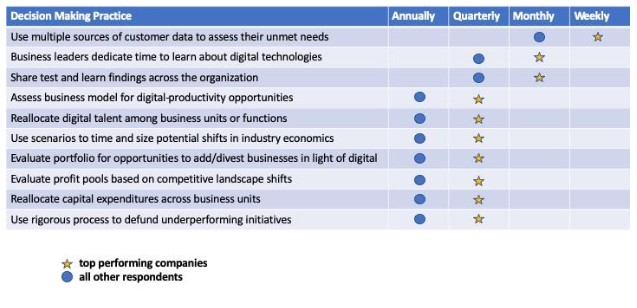
As you can see from the chart above, in all 10 decision making practices, top performing companies increased the frequency and repetition of each one. In doing so, they are acknowledging the necessity to adjust and accelerate their businesses’ decision-making cadence.
Decision making clarity is a mission critical success factor

In too many organizations, decision-making authority is determined by the hierarchical management structure that supports a silo-based business unit operating model. This fragmented approach to decision making increases decision latency and undermines decision accountability.
Those companies that excel at decision making have deployed clear decision-making governance programs that identify and delegate clear decision-making rights and accountability throughout the entire organization. They are deploying a faster and more nimble process that pushes as many decisions as they can as close to the customer as possible. The evidence continues to grow that as computing continues to move out to the point of customer contact decision making has to move to that point as well.
Here are some questions that I’ve found helpful in my work with C-Suite executives to improve the clarity of their company’s decision-making:
What are the most important decisions your company needs to make in order to be successful?
Why are they important?
Where do they fall short today?
What is required to improve them?
The answers to these questions serve to:
- Clarify what decisions are mission critical
- Identify who owns and is accountable for those decisions
- Identify who else in the organizations needs to support those decisions
- Clarify what is needed to make a good decision
How can your company leverage AI to make better decisions?

The unprecedented acceleration of disruption to legacy systems and processes from AI, GenAI and Agentic AI has forced C-Suite leaders across all industries to make a series of trade-off decisions. What percentage of the company’s scarce resources and budgets should go to stabilizing and securing its systems of record vs. building and deploying its new systems of engagement and systems of intelligence?
In too many cases, these decisions are made on an either-or basis not a both and basis which is a death knell to successful new innovations, and also undermines building a culture of creativity and collaboration. The solution is to find the right decision-making balance between running the business you have and growing the business you want.
- What is holding your company back from achieving its full growth potential?
- What percentage of your 2026 budget and resources are allocated to running the business functions vs. growing the business functions?
- Is your company’s productivity being held back by your legacy systems, processes and workflows?
- How can your company successfully utilize AI, GenAI & Agentic AI to increase its business valuation?
Some decision-making lessons to be learned

In the work I’ve been doing with C-Suite decision makers, here are some of lessons we’ve learned from and adopted:
- Decision making effectiveness drives business performance and employee engagement
- Top performing companies significantly increased the frequency and repetition across all major decision-making practices
- Hierarchical management structures and silo based operating models create decision making bottlenecks and roadblocks
- Good decision-making governance identifies and delegates decision making rights and accountability throughout the entire organization
- Edge computing will necessitate the need for edge decision making
- Most decisions should prioritize progress over perfection and quickly share the learning and insights from early experiments or mistakes
- It’s critical to differentiate short term performance decisions from long term business growth decisions
If you have additional lessons, you think can and should be learned, please send them to me. As I said, the need to make faster and better decisions is a mission critical success factor to successfully compete as a digital enterprise. As such, anything you are willing to share would be much appreciated.
|